What creates value
beyond performance?
The team examined service practices and wider customer behaviours, bringing emotional ritual, relationships and technical transparency into the discussion.
Presentation pp. 5-15, 32-35
NABA x Mercury / Collaborative course project
From engine performance
to ownership confidence.
01 / The research
The brief was to identify opportunities to improve Mercury's service experience. Our research looked beyond the engine itself, to how people choose, receive and live with it.
The team examined service practices and wider customer behaviours, bringing emotional ritual, relationships and technical transparency into the discussion.
Presentation pp. 5-15, 32-35
Partner accounts described the dealer-led relationship, reassurance during waiting, the first handover and the indirect route taken by feedback.
Presentation pp. 18-20 / Partner perspective, not owner interviews
The relationship is delivered by many actors.
The owner experiences one journey.
02 / The customer journey
Nine steps connect discovery to a future upgrade. This condensed reading of the team's journey map brings the service discontinuities into focus.
Before purchase
Engine decisions can disappear inside the wider boat purchase.
Boat shows / technical sheets / dealer consultations
The team journey identifies preselected options, unclear trade-offs and technical details lost in boat paperwork. The need is an explanation that connects engine choices to actual use.
Team journey, p. 22 / Opportunity areas 01 / 02
Waiting & handover
A long wait and a rushed briefing can weaken an important first impression.
Progress updates / dealer contact / engine briefing
Partner accounts describe the importance of progress photos and continued contact. The journey highlights the need for a hands-on handover that builds familiarity with the engine and its controls.
Team journey, p. 22 / Opportunity areas 03 / 04
Life on the water
Feedback and support cross several organisations before reaching the brand.
Service calls / captain feedback / follow-up conversations
The journey exposes indirect feedback, uncertain support responsibilities and missing follow-up. Continuity means connecting the owner, dealer, builder and engine brand beyond delivery.
Team journey, p. 22 / Opportunity areas 05 / 06 / 07
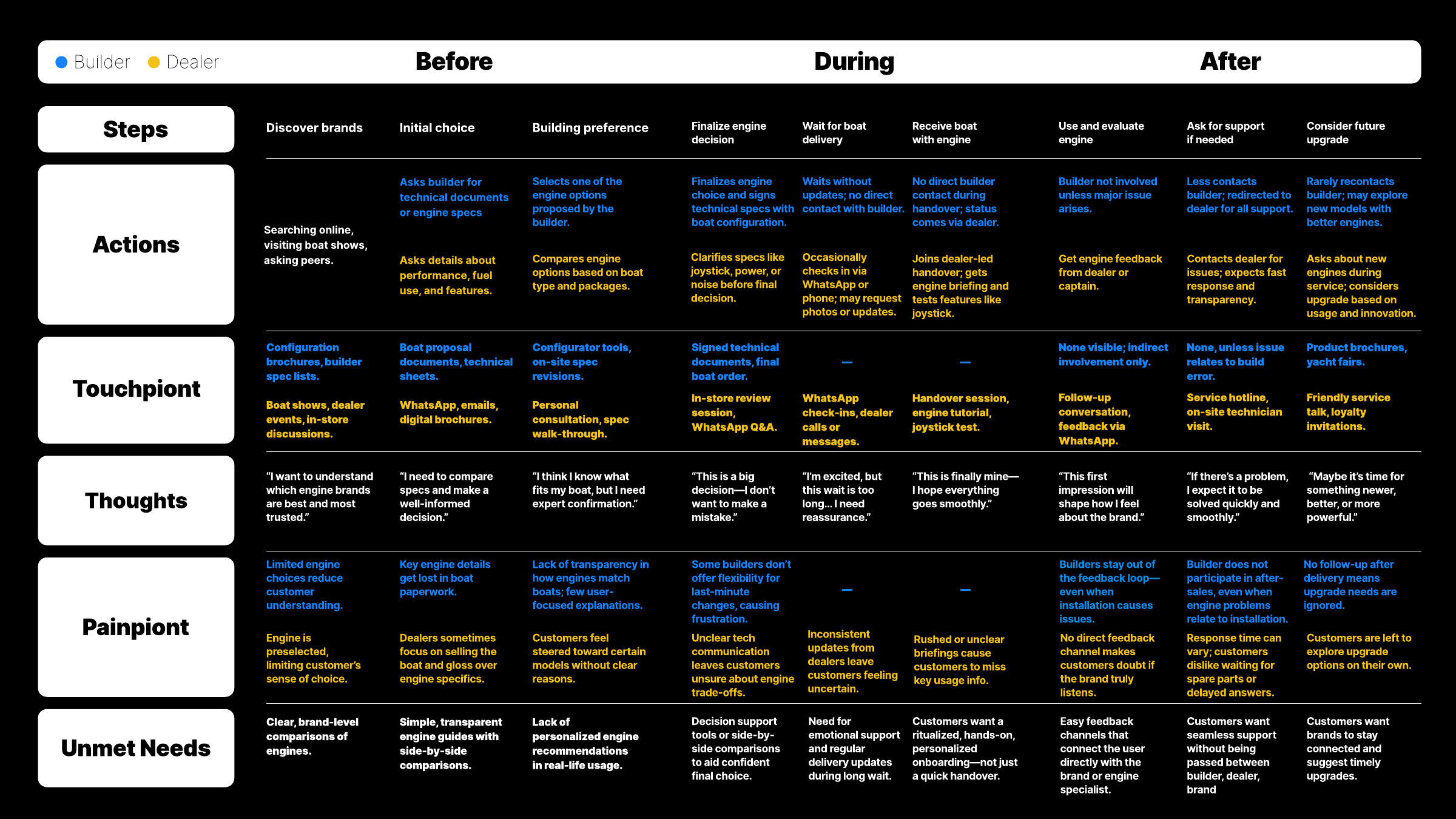
The original team map connects actions, touchpoints and unmet needs across the ownership experience.
View full-resolution map (opens in a new tab)Mapped thoughts are team interpretations, not direct owner quotations.
03 / From evidence to direction
The original seven opportunity areas, organised here into three reading themes. These are research-led directions, not launched or validated services.
Engine-specific guidance can be overshadowed by the boat sale; customers still need expert advice.
Interview synthesis, p. 18; journey, p. 22
Make engine brands easier to understand and compare before a choice is fixed.
Connect recommendations and side-by-side comparisons to real boating needs.
Continued contact reassures customers while they wait. Handover combines practical instruction with an emotional first experience.
Interview synthesis, p. 19; journey, p. 22
Provide regular progress updates and reassurance before delivery.
Make onboarding hands-on, personal and confidence-building.
Dealers mediate support and feedback; proactive contact can reveal future needs.
Interview synthesis, pp. 19-20; journey, p. 22
Bring owner feedback closer to the engine brand and its specialists.
Clarify responsibilities across dealer, builder and Mercury.
Use follow-up conversations to identify relevant upgrade needs.
Opportunity areas: presentation pp. 24-30. The three-theme grouping is editorial, not a research ranking.
04 / My contribution
My main contribution was synthesizing case research and interview findings into a structured customer journey and service opportunity areas, while shaping the presentation narrative to connect evidence with design direction.
The outcome was a shared research framework and a set of service directions. It was not an implemented service or a measured improvement in customer experience.
Context. A formal NABA x Mercury collaborative course project, confirmed by the author. The research and presentation were team work; the role above describes my contribution, not sole ownership.
Source. The supplied 37-page Research on the Mercury Project presentation. Interview material represents SACS partner accounts. Sample size and direct owner validation are not established by the supplied evidence.
Boundaries. Interviewee estimates are not quantitative results. Slide allocations do not establish sole authorship. The presentation uses different value-area counts in its summary and appendix; no definitive count is asserted here. The existing portfolio cover supplies visual context, not research evidence.
Next questions. Validate these tensions with owners and captains, map responsibility with service partners, and test whether clearer comparisons, updates and handovers address the needs identified. These are proposed next steps, not completed work.